
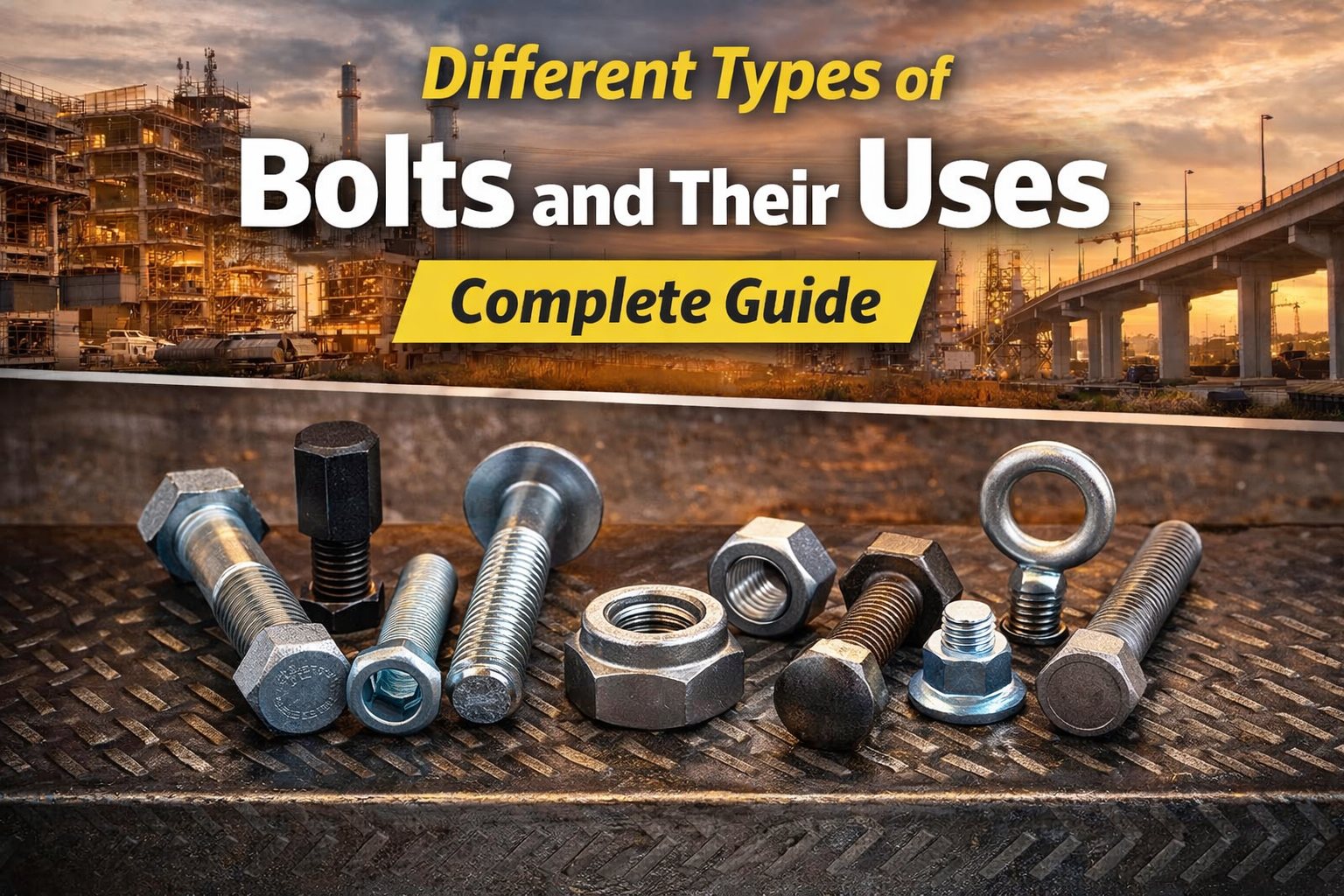
Bolts may look simple, but they play a major role in modern engineering. From bridges and buildings to vehicles and industrial machines, bolts hold structures together safely and reliably. Without them, assembling mechanical systems would become difficult and far less secure.
Engineers choose bolts because they create strong mechanical joints that can also be removed when maintenance becomes necessary. Unlike welding or permanent joining methods, bolts allow parts to be separated and replaced without damaging the components.
According to the Machinery’s Handbook, one of the most respected engineering references, threaded fasteners remain the most widely used method of mechanical joining in industrial applications. Their reliability, standardization, and strength make them essential across almost every engineering field.
This guide explains the different types of bolts and their uses, how they work, and where industries commonly apply them.
What Is a Bolt?
A bolt is a threaded fastener designed to hold materials together with the help of a nut. The bolt passes through aligned holes in the joined parts, and the nut tightens onto the threaded end to create a secure clamping force.
Bolts normally consist of three main parts:
- Head – the top portion used for tightening with tools
- Shank – the smooth section below the head
- Threaded end – the portion that engages with the nut
Engineers select different bolt types based on factors such as load capacity, environment, vibration, and material strength.
Why Choosing the Right Bolt Matters
Selecting the correct bolt ensures safety, durability, and performance. Using the wrong bolt can lead to mechanical failure, structural damage, or expensive repairs.
Engineers usually consider:
- Load and stress levels
- Environmental exposure
- Corrosion resistance
- Vibration conditions
- Material compatibility
The American Society of Mechanical Engineers (ASME) and International Organization for Standardization (ISO) both publish global fastener standards that help manufacturers produce bolts with consistent dimensions and strength.
Common Types of Bolts and Their Uses
Many bolt designs exist, each created for a specific mechanical purpose. Below are some of the most widely used bolt types in construction, manufacturing, and engineering industries.
Hex Bolts
Hex bolts are among the most common bolts used in engineering and construction. They feature a six-sided head that allows tightening with a wrench or spanner.
Because of their simple design and strong grip, engineers use hex bolts in many applications.
Common uses include:
- Steel structures
- Construction frameworks
- Industrial machinery
- Automotive assemblies
Hex bolts follow standardized dimensions such as DIN, ISO, and ASTM, which ensures compatibility with nuts and tools worldwide.
Their versatility explains why hex bolts appear in almost every mechanical workshop on the planet.
Carriage Bolts
Carriage bolts feature a smooth rounded head and a square neck below the head. The square section locks into the material and prevents the bolt from rotating during tightening.
This design makes carriage bolts ideal for wood connections.
Common applications include:
- Wooden structures
- Furniture assembly
- Bridges and decks
- Agricultural equipment
The smooth head also provides a clean appearance, which explains why furniture manufacturers often prefer carriage bolts.
Lag Bolts
Lag bolts, often called lag screws, are heavy-duty fasteners designed for wood structures. Unlike standard bolts, lag bolts usually thread directly into wood without a nut.
Their coarse threads allow strong grip and high load capacity.
Builders use lag bolts in:
- Timber construction
- Deck building
- Wooden beams
- Structural wood framing
The American Wood Council recommends lag screws and bolts for many heavy wood structural connections because they provide reliable holding power.
Socket Head Bolts (Allen Bolts)
Socket head bolts, commonly known as Allen bolts, contain a hexagonal socket in the bolt head. Technicians tighten them using an Allen key instead of a wrench.
These bolts work especially well when space around the bolt head is limited.
Engineers often choose Allen bolts for:
- Industrial machinery
- Automotive components
- Machine tools
- Robotics systems
Because of their compact design and ability to handle high torque, Allen bolts remain popular in precision engineering applications.
Flange Bolts
Flange bolts include a circular flange under the bolt head that acts like a built-in washer. This flange spreads the load over a larger area and helps reduce damage to the surface material.
Flange bolts often appear in automotive and heavy machinery industries.
Typical uses include:
- Automotive engine assembly
- Heavy machinery
- Structural metal connections
The integrated washer also reduces the need for separate washers, which simplifies installation.
Stud Bolts
Stud bolts differ from standard bolts because they contain threads on both ends instead of having a head. Nuts secure both sides of the connection.
Industries commonly use stud bolts in high-pressure and high-temperature environments.
Typical applications include:
- Oil and gas pipelines
- Pressure vessels
- Heat exchangers
- Petrochemical plants
The ASME B16.5 flange standard widely specifies stud bolts for connecting pipeline flanges.
Eye Bolts
Eye bolts feature a loop or circular ring at the top instead of a traditional bolt head. This ring allows ropes, chains, or cables to attach to the bolt.
Engineers use eye bolts mainly for lifting or securing loads.
Common applications include:
- Lifting equipment
- Rigging systems
- Marine hardware
- Construction lifting points
Proper installation is essential because lifting loads place significant stress on the bolt.
Anchor Bolts
Anchor bolts secure structural elements to concrete foundations. They typically embed into concrete during construction to create strong anchoring points.
Engineers use anchor bolts in:
- Building foundations
- Structural steel columns
- Industrial machinery installation
- Bridge construction
Anchor bolts provide stability and help structures resist forces such as wind or seismic activity.
Materials Used for Bolts
Bolt performance depends heavily on the material used during manufacturing.
Manufacturers commonly use the following materials.
Carbon Steel Bolts
Carbon steel bolts remain the most widely used fasteners in general construction and machinery.
They offer:
- High strength
- Good durability
- Affordable cost
However, carbon steel may corrode if exposed to moisture or chemicals without protective coatings.
Stainless Steel Bolts
Stainless steel bolts provide excellent corrosion resistance due to their chromium content.
Industries often use stainless steel bolts in environments exposed to:
- Moisture
- Chemicals
- Outdoor weather
Common applications include marine equipment, food processing machinery, and outdoor construction.
Alloy Steel Bolts
Alloy steel bolts contain additional elements such as chromium, molybdenum, or nickel. These materials increase strength and heat resistance.
Heavy industries often rely on alloy steel bolts in high-stress environments.
Typical uses include:
- Power plants
- Oil and gas systems
- Heavy machinery
- High-temperature equipment
Bolt Strength Grades
Bolt strength varies depending on its grade. Strength grades indicate how much load a bolt can safely handle.
Two common systems exist:
Metric Bolt Grades
Metric bolts often follow ISO standards, with common grades including:
- Grade 8.8 – medium strength structural bolts
- Grade 10.9 – high strength bolts used in heavy machinery
- Grade 12.9 – very high strength bolts used in demanding mechanical systems
SAE Bolt Grades
In the SAE system used in North America, common grades include:
- Grade 5 – medium strength bolts
- Grade 8 – high strength bolts for heavy-duty applications
Selecting the correct grade ensures safe and reliable performance.
Common Bolt Coatings
Manufacturers often apply protective coatings to bolts to improve durability and corrosion resistance.
Common coatings include:
- Zinc plating
- Hot-dip galvanizing
- Black oxide coating
- Phosphate coating
These coatings extend bolt life, especially in outdoor or industrial environments.
Tips for Choosing the Right Bolt
Choosing the right bolt requires careful consideration of several factors.
Engineers normally evaluate:
- Load capacity
- Environmental exposure
- Material compatibility
- Vibration levels
- Required bolt strength grade
Selecting the correct bolt may seem simple, but even a small mistake can compromise structural safety.
A good engineer respects bolts because even a tiny fastener can hold together massive structures.
Final Thoughts
Bolts may look small, but they play a powerful role in modern engineering. From hex bolts used in construction to stud bolts used in oil pipelines, each bolt type serves a specific purpose.
Understanding the different types of bolts and their uses helps engineers, technicians, and builders select the right fastener for every job.
When the correct bolt meets the correct application, machines run smoothly, structures remain stable, and engineers avoid unpleasant surprises.
And honestly, if a tiny piece of metal can hold together a multi-ton machine, it deserves more credit than it usually gets.