
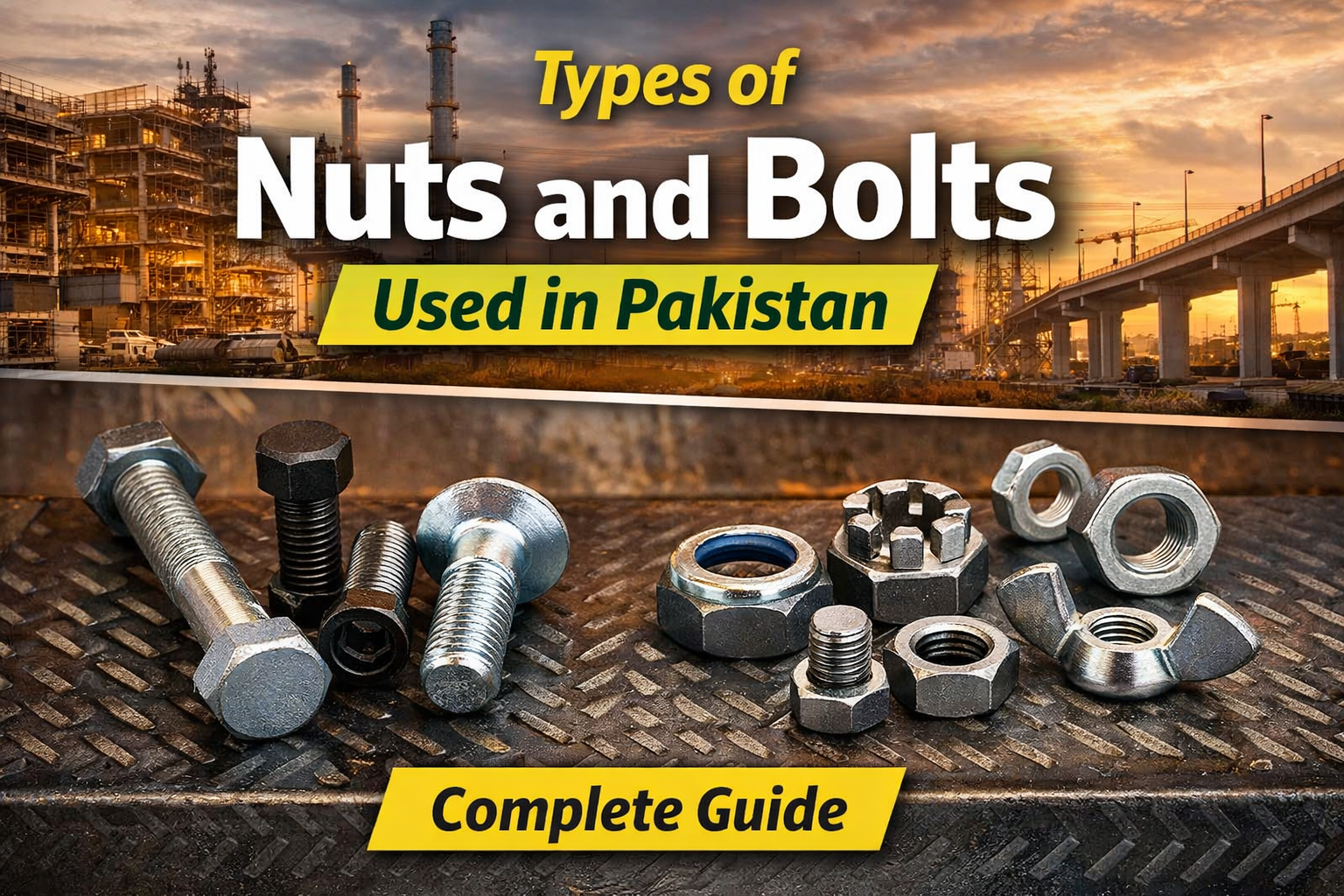
Nuts and bolts might look small, but they hold together the machines, buildings, and vehicles that shape everyday life. From large construction sites in Karachi to small repair workshops in Gujranwala, these fasteners play a crucial role in engineering and manufacturing.
In Pakistan, industries such as construction, automotive, machinery manufacturing, and energy depend heavily on different types of nuts and bolts. Each fastener type serves a specific purpose, and choosing the correct one can improve safety, durability, and performance.
This guide explains the types of nuts and bolts commonly used in Pakistan, their uses, and why they matter in industrial and construction applications.
Why Nuts and Bolts Matter in Engineering
Fasteners connect two or more components securely. Engineers prefer nuts and bolts because they allow easy assembly and disassembly without damaging parts.
A bolt usually works with a nut to clamp objects together. The bolt passes through aligned holes in the materials, and the nut tightens on the threaded end to create a secure joint.
According to the Machinery’s Handbook, one of the most widely referenced mechanical engineering resources, threaded fasteners remain the most common mechanical joining method worldwide due to their strength and reliability.
In Pakistan, fasteners appear in:
- Construction projects
- Automotive manufacturing
- Industrial machinery
- Steel structures
- Oil and gas equipment
- Agricultural machinery
Without these small components, modern engineering simply would not function.
Common Types of Nuts Used in Pakistan
Different nuts provide different levels of locking strength, vibration resistance, and load capacity. The following nuts appear frequently in Pakistani industries.
Hex Nut
The hex nut stands as the most widely used nut in Pakistan and around the world. Its six-sided shape allows easy tightening with a wrench or spanner.
Engineers use hex nuts in:
- Steel structures
- Machinery assembly
- Automotive components
- Industrial equipment
Most hex nuts follow international standards such as ISO, DIN, or ASTM, which ensures compatibility with bolts produced worldwide.
Because of their simple design and reliability, hex nuts often serve as the default fastener in mechanical systems.
Nylon Lock Nut
A nylon lock nut, also called a nyloc nut, includes a nylon insert inside the nut. When the bolt threads into the nut, the nylon ring creates friction and prevents loosening.
This design works especially well in environments where vibration occurs.
Common uses include:
- Automotive suspension systems
- Industrial machinery
- Equipment exposed to vibration
The NASA Fastener Design Manual highlights nylon lock nuts as effective vibration-resistant fasteners in many engineering applications.
Castle Nut
A castle nut features slots cut into one end, giving it a castle-like appearance. Engineers usually pair this nut with a cotter pin inserted through the bolt.
This system prevents the nut from loosening, even under heavy vibration.
Castle nuts appear frequently in:
- Automotive wheel hubs
- Steering systems
- Mechanical linkages
Their locking mechanism adds extra safety in critical mechanical systems.
Wing Nut
A wing nut allows tightening and loosening by hand. Two wing-like projections make manual operation easy without tools.
Wing nuts work best in situations where frequent adjustments occur.
Typical applications include:
- Temporary fixtures
- Clamping systems
- Furniture assembly
- Light equipment setups
Because of their convenience, technicians often use wing nuts in maintenance environments.
Coupling Nut
A coupling nut connects two threaded rods or bolts together. Its elongated shape allows threads to extend deeper into the nut.
Industries in Pakistan often use coupling nuts for:
- Structural steel assemblies
- Threaded rod connections
- Machinery installations
These nuts help extend bolt length when standard bolts are not long enough.
Cap Nut
A cap nut, also known as an acorn nut, has a closed end that covers the exposed bolt threads.
This design offers two advantages:
- It protects the threads from corrosion.
- It improves safety by covering sharp edges.
Cap nuts commonly appear in:
- Decorative applications
- Furniture assembly
- Bicycle components
- Light machinery
Common Types of Bolts Used in Pakistan
Just like nuts, bolts also come in many designs. Each bolt type supports a specific mechanical or structural function.
Hex Bolt
The hex bolt remains one of the most common bolts used worldwide and across Pakistan. It features a six-sided head and threaded shaft.
Industries rely on hex bolts for:
- Construction structures
- Industrial machinery
- Automotive parts
- Steel fabrication
Because hex bolts follow international standards, engineers can easily source them from global suppliers.
Allen Bolt (Socket Head Bolt)
An Allen bolt, also called a socket head cap screw, features a hexagonal recess in the bolt head. Instead of using a wrench, technicians tighten it with an Allen key.
Engineers often select Allen bolts when:
- Space around the bolt head is limited
- High torque is required
- A clean and compact design is preferred
Allen bolts appear frequently in:
- Machine tools
- Industrial equipment
- Robotics and automation systems
Carriage Bolt
A carriage bolt includes a smooth rounded head and a square neck beneath it. When installed, the square section locks into the material and prevents the bolt from spinning.
Carriage bolts work particularly well in wood and construction materials.
Common uses include:
- Wooden structures
- Furniture frames
- Bridges and decks
Stud Bolt
A stud bolt differs from standard bolts because it has threads on both ends. Nuts secure both sides of the connection.
Stud bolts are essential in industries such as:
- Oil and gas
- Petrochemical plants
- Pressure vessels
- Pipeline flanges
According to the American Society of Mechanical Engineers (ASME), stud bolts play a vital role in high-pressure flange connections.
Flange Bolt
A flange bolt includes a circular flange under the bolt head. This flange distributes pressure evenly across the surface.
Engineers often use flange bolts in:
- Automotive engines
- Heavy machinery
- Structural applications
The built-in washer eliminates the need for a separate washer in many assemblies.
Lag Bolt (Lag Screw)
A lag bolt, sometimes called a lag screw, is designed for heavy wood construction. It features a coarse thread and a pointed end.
Lag bolts commonly appear in:
- Wooden beams
- Structural timber connections
- Construction frameworks
Because they grip wood strongly, builders rely on lag bolts in heavy-duty carpentry.
Materials Used for Nuts and Bolts in Pakistan
The material of a fastener determines its strength, corrosion resistance, and durability.
Common materials include:
Carbon Steel
Carbon steel fasteners remain the most widely used option in Pakistan due to their strength and affordability.
They appear in:
- Construction projects
- General machinery
- Industrial equipment
Stainless Steel
Stainless steel offers excellent corrosion resistance. Engineers prefer it in environments exposed to moisture or chemicals.
Typical applications include:
- Food processing equipment
- Marine environments
- Outdoor structures
Alloy Steel
Alloy steel fasteners provide higher strength and heat resistance. Heavy machinery and energy industries often require these fasteners.
How to Choose the Right Fastener
Selecting the correct nut and bolt requires careful consideration.
Engineers usually evaluate:
- Load requirements
- Environmental conditions
- Vibration levels
- Material compatibility
- Safety standards
Using the wrong fastener may lead to equipment failure or structural damage. Even the strongest bolt cannot save a poorly designed joint.
Fastener Manufacturing in Pakistan
Pakistan has a growing fastener manufacturing sector. Cities like Gujranwala, Lahore, and Karachi host several manufacturers producing nuts, bolts, and industrial fasteners.
Local manufacturers supply products for:
- Construction industries
- Automotive spare parts markets
- Agricultural equipment
- Industrial machinery
Many manufacturers follow international standards such as DIN, ISO, and ASTM to ensure compatibility with global engineering practices.
Final Thoughts
Nuts and bolts may look simple, but they form the backbone of mechanical and structural engineering. In Pakistan, industries rely on a wide range of fasteners, from basic hex nuts to specialized stud bolts used in high-pressure systems.
Understanding the different types of nuts and bolts used in Pakistan helps engineers, contractors, and manufacturers choose the right fastener for each job. When the correct fastener meets the correct application, structures stay secure, machines operate smoothly, and engineers sleep a little better at night.
And honestly, if a tiny bolt can hold together a massive steel bridge, it deserves at least a little respect.